ChatGPT Has Evolved: From Answering to Empowering Users
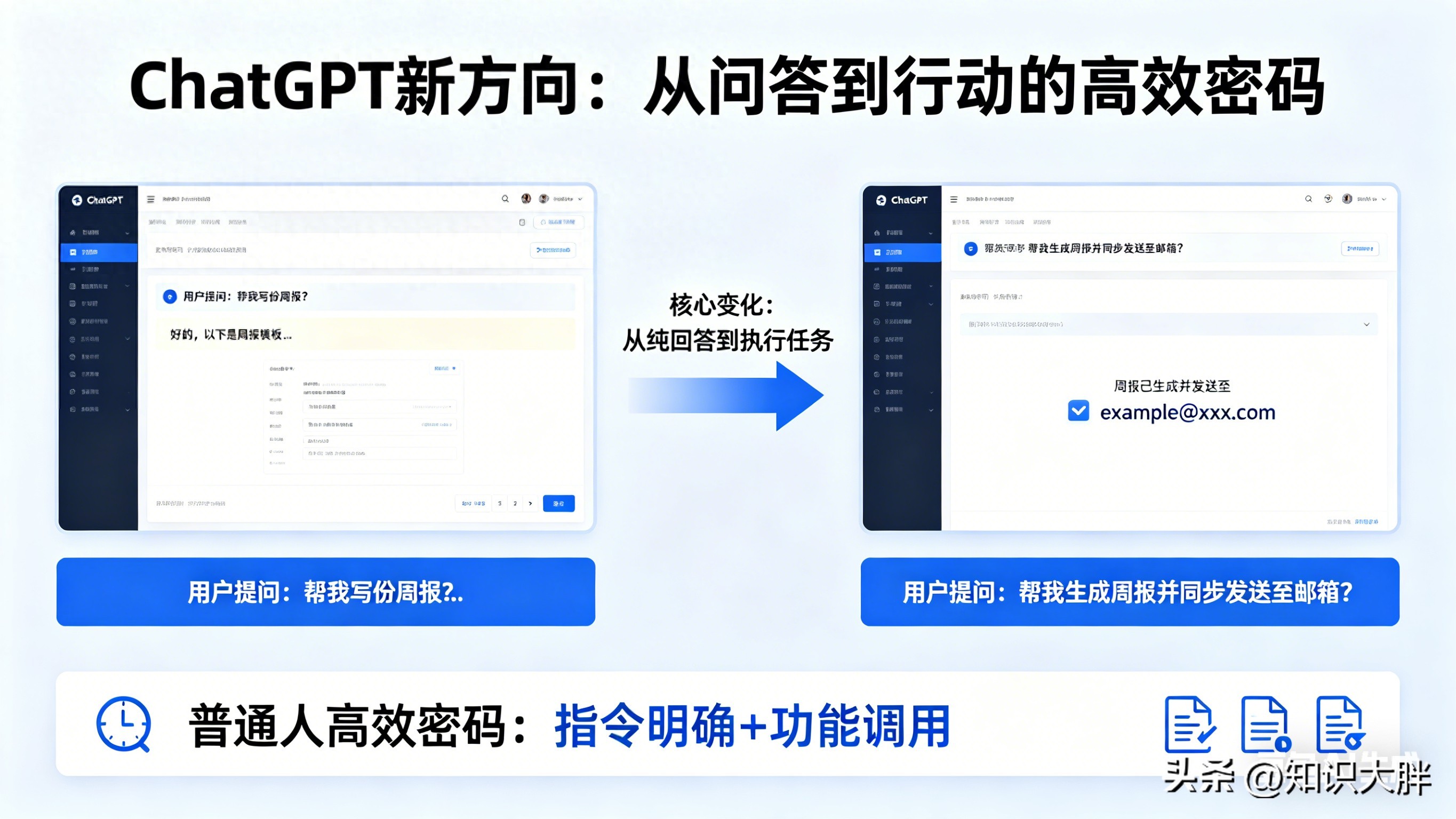
1. ChatGPT is No Longer Just a Q&A Tool
Many people still view ChatGPT as a sophisticated search engine—ask a question, get an answer, and forget about it, believing it is no different from ordinary AI. However, it has quietly undergone a significant upgrade, breaking free from the limitations of merely providing answers.
Previously, if you asked it “how to write a workplace report,” it would only provide a template, leaving you to figure out the framework, content, and logic on your own. Now, when you ask the same question, it not only gives you a template but also helps you outline the core points of the report, suggests adding highlights, and even helps you avoid common pitfalls in expression, acting like a silent partner at work.
This seemingly small shift reveals a new direction for ChatGPT—it is no longer a tool that passively executes commands but an active partner that helps move things forward. Many people are still wasting this core value that could help them avoid detours and improve efficiency, which is why some find it incredibly useful while others feel it is “useless.”
2. Key Changes: From “Providing Answers” to “Guiding Directions”
The new direction of ChatGPT is centered around one core change: from “passive response” to “active assistance.” Previously, it was a one-way output of “you ask, I answer”; now it is a two-way collaboration of “you ask, I help.” This change manifests in three key aspects, each addressing our core pain points directly.
1. Shift in Core Objective: From “Seeking Correctness” to “Facilitating Progress”
In its early days, ChatGPT’s main task was to provide “correct answers.” You could ask it a math question, and it would give you the precise result; you could ask it for an explanation of a concept, and it would provide a rigorous response, ending the task there, leaving you to make the connections.
Now, its core task has shifted to “helping you move things forward.” If you ask a math question, it will not only calculate the result but also suggest, “this problem-solving approach can be optimized, and there are simpler methods.” Similarly, when asking about a concept, it will help you outline the logical framework and suggest how to remember it in context.
The difference is like asking someone for directions to the bus station; previously, they would just tell you to take bus number 3. Now, they would guide you to take bus number 3, get off at a specific stop, walk a certain distance, and avoid construction, saving you time.
2. Shift in User Experience: From “Mental Strain” to “Energy Savings”
Many people avoid using ChatGPT not because they find it useless, but because they feel it adds to their mental burden—after asking for an answer, they still have to organize their thoughts and plan steps, which increases cognitive load. This was one of the biggest limitations of early ChatGPT: it provided “raw materials” without processing them.
Now, ChatGPT addresses this pain point by actively helping you organize your thoughts, plan steps, and point out potential oversights, relieving you from the stress of deciding what to do next. For instance, if you want to write product copy, you no longer have to struggle with how to start or highlight selling points; it will help you structure the copy and suggest key advantages, even providing several opening options, allowing you to quickly draft a version.
This shift essentially saves us from the agonizing process of “starting from scratch,” reducing ineffective internal friction and allowing us to focus on more critical decisions.
3. Shift in Positioning: From “Tool” to “Partner”
It is essential to clarify that ChatGPT is still fundamentally a tool; it lacks emotions, personal intentions, and true understanding of your feelings. However, its response style is increasingly resembling that of a “silent partner”—not stealing the spotlight or causing disruption, but ready to lend a hand and guide you when needed.
It remembers your previous questions and adjusts its response logic accordingly. For example, if you first ask it, “how to create a marketing plan,” and then ask, “how to optimize the conversion rate of the plan,” it won’t disregard your earlier request but will provide targeted optimization suggestions based on your previous framework. It won’t make decisions for you, but it can offer sufficient references to help you avoid pitfalls and take fewer detours.
3. Dialectical Analysis: Is ChatGPT’s Upgrade a Benefit or a Trap?
Undeniably, ChatGPT’s new direction brings significant convenience to our work and learning. It helps us break through bottlenecks, enhances efficiency, and simplifies seemingly complex tasks—this is its irreplaceable value and core selling point.
However, we should not blindly praise this upgrade without recognizing its potential issues. First, its “active assistance” may lead to dependency. If we rely on it to organize thoughts and plan steps for everything, over time, our own thinking and planning abilities may decline, turning us into “executors who cannot think.”
Second, while its suggestions are convenient, they may not always be suitable for you. ChatGPT’s responses are based on big data training and lack personalized judgment; the steps and suggestions it provides may not fit your specific context or capabilities. Blindly following them could backfire. For example, a study plan it helps you create might be overly ambitious, leading to anxiety instead of success.
Moreover, we should ponder: is ChatGPT’s core value to “save us effort” or to “help us grow”? True efficiency has never been about “not thinking” but about “avoiding unnecessary detours and focusing energy on what matters.” Balancing “tool dependency” and “self-improvement” is the key issue we must address in light of ChatGPT’s new direction.
4. Practical Implications: How Ordinary People Can Seize New Opportunities with ChatGPT
ChatGPT’s new direction is not about “replacing humans” but about “assisting humans.” It addresses our most frustrating “internal friction”—not a lack of ideas, but not knowing how to implement them effectively; not an inability to work, but not knowing how to work efficiently.
For professionals, it can help you quickly outline work thoughts, optimize reporting content, and enhance copywriting efficiency, allowing you to escape tedious tasks and focus on core business, accelerating career advancement. For students, it can help you organize knowledge points, plan study schedules, and answer difficult questions, reducing learning detours and improving efficiency. For entrepreneurs, it can help you outline business ideas, optimize business plans, and analyze market needs, lowering the trial-and-error costs in the early stages of entrepreneurship.
But remember, it is just an auxiliary tool. Ultimately, your thinking ability, decision-making capability, and execution skills determine your success or failure. ChatGPT can help you plan steps but cannot execute them; it can help you organize thoughts but cannot make judgments; it can help you avoid pitfalls but cannot bear risks.
Winning has never been about taking shortcuts with tools but about using tools to become more efficient and excellent. ChatGPT’s new direction offers us an opportunity to “reduce internal friction and increase progress,” and whether we can seize this opportunity depends on our mindset and usage.
Comments
Discussion is powered by Giscus (GitHub Discussions). Add
repo,repoID,category, andcategoryIDunder[params.comments.giscus]inhugo.tomlusing the values from the Giscus setup tool.